

Flying to the Alps for skiing, Geneva, Sion, Samedan and the altiports
From Geneva’s long runway to the steep strip at Courchevel. How the Alpine airports differ, what winter does to schedules and how to fly with skis.
A ski trip by private aircraft is mostly a question of how close to the snow you can land. The Alps offer everything from a 3,900 m runway at Geneva to a strip of little more than 500 m on a mountainside at Courchevel. Each step closer to the resort brings tighter rules, smaller aircraft and more dependence on the weather. Here is how the main airports compare in winter.
Geneva, the main gateway
Geneva (GVA) has the longest runway in Switzerland at 3,900 m, an elevation of 430 m and a dedicated business aviation terminal. Any aircraft can use it, and it is the usual arrival point for Verbier, Chamonix, Megève and, with a longer drive, the Tarentaise valley in France. From London it is about 410 nm (760 km), roughly 1 hour 30 minutes in a light jet.
The difficulty in winter is capacity rather than runways. Geneva is slot coordinated, has a night curfew and limits aircraft parking; layovers of more than three hours need prior approval. Many chalets and tour operators change guests on Saturdays, so winter weekends in the school holidays are the tightest days of the season. At those times the operator may drop you off and park the aircraft elsewhere or fly it home empty, and charge for the positioning.
As a rough example using the indicative bands for autumn 2026, a 1 hour 30 minute flight in a light jet costs about EUR 5,700 to 7,800 in flight time, before VAT, fees and positioning.
Sion and Samedan, closer to the snow
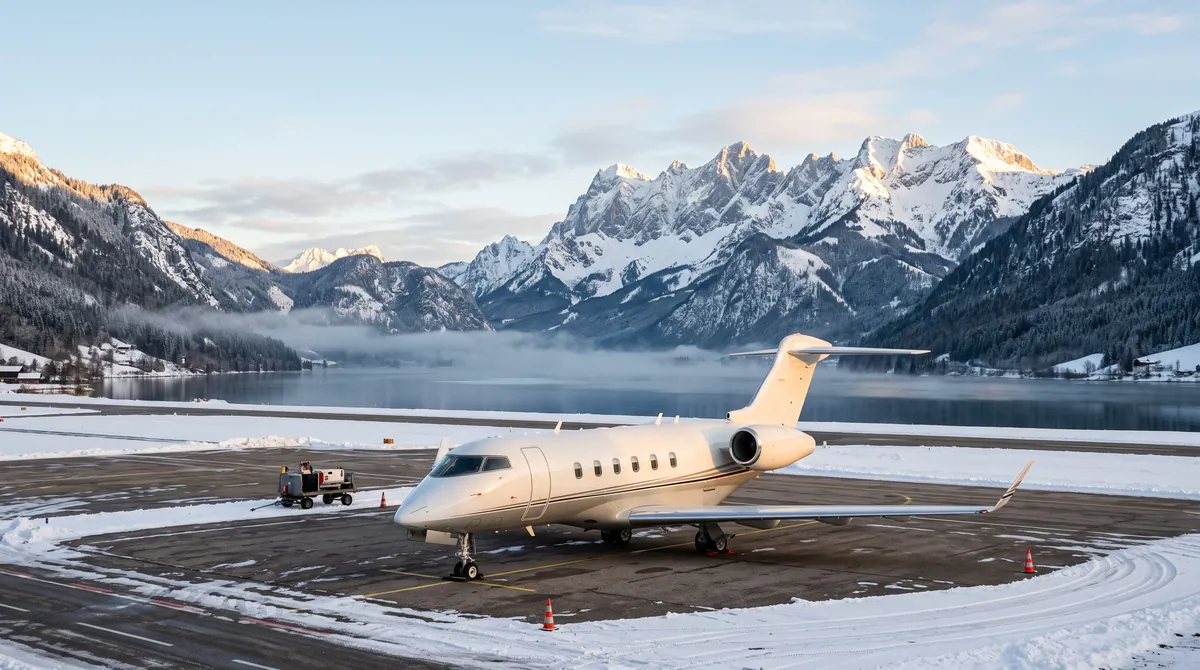
Sion (SIR), in the Rhône valley at 483 m, has a 2,000 m runway and is the closest airport able to take jets for Verbier and Crans-Montana. Approaches follow the valley with high terrain on both sides, and light and midsize jets are the usual visitors.
Samedan (SMV) in the Engadin, a few kilometres from St. Moritz, sits at about 1,707 m (5,600 ft) and is one of the highest airports in Europe. Its runway is about 1,800 m. Every pilot must complete the airport’s familiarisation briefing and online test, valid for 24 months, before flying there. There is no instrument landing system, only satellite-based approaches, and no runway lighting, so flights are planned for daylight.
At that height the thin air reduces engine and wing performance, an effect pilots call . A jet may have to leave with less fuel or fewer passengers than it would at sea level, which can mean a fuel stop on a long first leg. Local winds, such as the Maloja wind blowing down the valley, also shape the day’s operations.
The French Alps and the Courchevel altiport
Chambéry Savoie Mont Blanc (CMF) has a 2,020 m runway and is the closest larger airport to the Tarentaise resorts: Courchevel, Méribel, Val Thorens and Val d’Isère. Its traffic is heavily concentrated on winter weekends. Grenoble Alpes Isère (GNB), with a 3,050 m runway, is the gateway for the Oisans resorts such as Alpe d’Huez and Les Deux Alpes.
The Courchevel is a different world. At about 2,008 m, its 537 m runway has a gradient of about 18.6%. Aircraft land uphill and take off downhill, and there is no go-around procedure, so once committed to the approach the pilot must land. The strip has no lighting and no instrument approach, which rules out flying in cloud or fog.
Pilots need a mountain rating or a site-specific authorisation for the altiport, with recent landings there, and commercial operators need their own approval. In practice the altiport is served by small turboprops such as the Pilatus PC-12 and by helicopters, not by jets. Most jet travellers land at Chambéry or Geneva and continue by road or helicopter. Turboprops sit at about EUR 2,400 to 3,400 per flight hour in the indicative bands.
There is no go-around procedure, so once committed to the approach the pilot must land.
Austria, Innsbruck and Salzburg
Innsbruck (INN), at 581 m with a 2,000 m runway, serves Tyrol and the Arlberg. Surrounding terrain makes it a airport, which means crews need specific training before flying there, and it has its own approach procedure for conditions. Operators who fly it regularly will have crews qualified for it; ask if you are unsure.
Salzburg (SZG), with a 2,750 m runway at 430 m, is less demanding and serves the resorts of Salzburger Land. Like Innsbruck, it sees seasonal airline traffic from ski tour operators, and weekends in the winter holidays are its busiest days.
Winter weather, de-icing and skis
Snow, low cloud and freezing fog can close mountain airports or delay departures, so allow slack in the schedule and agree a fallback airport with the operator. The fallback is usually a lower, larger airport with a longer drive, such as Geneva instead of Sion or Zurich instead of Samedan, so arrange ground transport for that case before you leave. Before take-off in icing conditions, aircraft are sprayed with heated fluid to remove snow and ice, often followed by a thicker fluid that protects the wings for a limited . De-icing takes time and is usually billed as an extra.
Skis need planning too. Tell the operator how many ski or snowboard bags, boot bags and helmets you will bring, and ask for the dimensions of the baggage hold; long bags do not fit every light jet, and a group of six with full ski kit can fill a small hold quickly. At high or short airports, weight matters for take-off performance, so accurate passenger and baggage figures help the crew plan.
Terms in this article
- Altiport
- A short mountain airfield, often with a sloping runway, serving a resort and limited to specially qualified pilots and small aircraft.
- Category C
- An airport so demanding that crews need specific training, such as a simulator session or a familiarisation flight, before operating there.
- Density altitude
- Air pressure and temperature expressed as an equivalent altitude; high values mean thinner air and weaker aircraft performance.
- Holdover time
- The period for which anti-icing fluid protects an aircraft’s surfaces before it must take off or be treated again.
- Föhn
- A warm, dry wind descending on the lee side of the Alps, often bringing strong turbulence near mountain airports.
Questions readers ask
Can a private jet land at the Courchevel altiport?
No. The altiport’s runway is only 537 m long with a gradient of about 18.6%, and it is used by small turboprops such as the Pilatus PC-12 and by helicopters, flown by pilots with the required qualification. Jet travellers to Courchevel usually land at Chambéry or Geneva and continue by car or helicopter. A turboprop direct to the altiport is possible from many airports in good weather.
Why are Saturdays so difficult at Alpine airports?
Many chalets and ski tour operators change guests on Saturdays, so arrivals and departures bunch up on the same day, especially in the school holidays. Airports such as Geneva limit slots and aircraft parking, and those limits bite hardest then. Flying on a Friday or Sunday, or choosing a less busy airport, often makes the trip easier and can reduce positioning costs.
Do I need to tell the operator about my skis in advance?
Yes. Long ski and snowboard bags need a baggage hold of the right length, and not every light jet has one. The crew also needs accurate weights, because take-off performance at high or short airports such as Samedan depends on them. Give the number and type of bags when you request the quote, so the operator can propose an aircraft that fits them.


