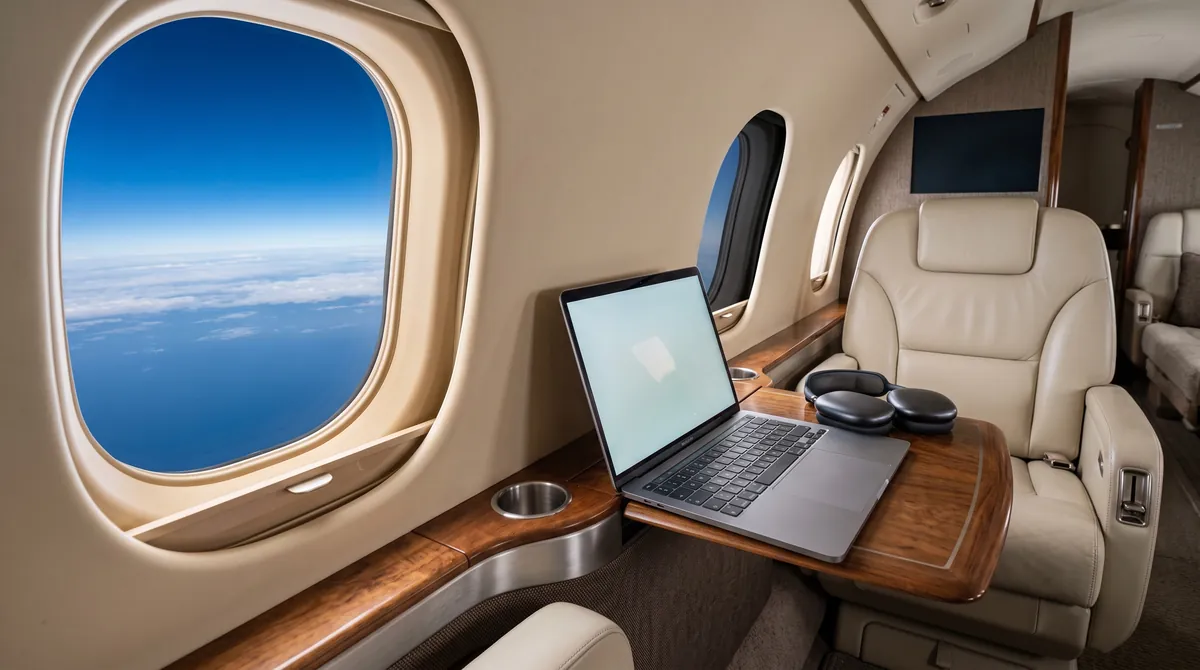
Luggage on a private jet, soft bags, skis and golf clubs
On a small jet, the shape of your bags matters more than their weight. How baggage space really works, what fits, and why telling the operator early saves trouble at the steps.
Airline travel teaches you to think about luggage in kilograms. On a business jet, the first question is not how much your bags weigh but whether they fit through the baggage door and into the space behind it. A pair of large hard cases can fill the hold of a light jet that would happily carry twice their weight in soft holdalls, and long items such as skis may not fit some types at all.
Volume and shape before weight
Baggage compartments on smaller jets are compact and irregular. They follow the curve of the fuselage, taper towards the tail, and their doors are often smaller than the space behind them. Whether a bag fits depends on its length, its rigidity and the size of the door, so a published capacity in cubic feet tells only part of the story. Two aircraft with similar figures can swallow very different loads.
As a broad guide, a very light jet suits two or three people with soft weekend bags. A light jet takes more, but rarely a large hard case for every passenger. Midsize and super midsize jets are where proper luggage for a week away becomes realistic for most seats, and on many larger jets the main hold is pressurised and reachable from the cabin in flight. Turboprops such as the Pilatus PC-12 NGX, and the Pilatus PC-24 jet, have large cargo doors that make bulky items far easier to load.
Soft bags, hard cases and the cabin
Soft bags are the natural choice for private flying. They compress, bend around a curved wall and can be pushed into the last corner of a hold. Hard shell suitcases with wheels and telescopic handles do the opposite: they keep their shape and leave dead space around them. If you own both, take the soft ones.
Not every bag has to go in the hold. Larger jets have a wardrobe for suits and dresses, and small bags can travel in the cabin provided they are stowed for take-off and landing and never block an exit. Using an empty seat for luggage is the crew’s decision, and anything placed there must be secured.
Wine, medicines, cameras and laptops deserve thought. On some smaller types part of the baggage space is outside the pressurised cabin or not heated to cabin standards, so ask before you pack anything sensitive to cold or pressure. Spare lithium batteries and power banks belong in the cabin in any case.
Skis, golf clubs, prams and wheelchairs
Skis and snowboards are the classic test. A bag for long freeride skis can exceed the usable length of a light jet’s hold, while shorter piste skis may fit. Give the operator the length of the packed bag, not of the skis, and ask whether that aircraft has carried similar loads before. For a winter trip to a mountain airport, the aircraft chosen for its short runway performance may not be the one with the longest hold.
Golf bags travel best in soft travel covers, because a rigid case is easier to load onto an airport conveyor than into a curved compartment. For four golfers, ask early: four bags plus four suitcases can be more than a light jet can take, and the answer may be a larger aircraft or sending the clubs ahead.
Prams and child seats should fold, and the operator needs their folded dimensions. A manual folding wheelchair is usually straightforward. A powered wheelchair or mobility scooter needs early discussion, partly because of its size and partly because its battery falls under rules. Help with boarding, such as a lift or a specialist chair, may be available at the airport but has to be booked in advance.
- Number of bags per passenger
- Length, width and depth of anything unusual
- Whether each case is hard or soft
- Approximate weight of heavy items
- Any batteries, firearms or other restricted items
Sporting guns and dangerous goods
Shotguns and rifles for a shooting trip can travel on a private jet, but never as a casual addition. The operator must agree in advance, guns travel unloaded in locked cases stowed out of passengers’ reach, and ammunition is classed as a dangerous good with strict limits. You also need permits at both ends. Residents of EU countries use the for travel between member states, and visitors to Great Britain need a visitor’s permit, which a sponsor living there must apply for well ahead of the trip. Elsewhere, allow weeks rather than days for import paperwork.
Private aviation does not suspend dangerous goods rules. Charter operators work within the same international framework as airlines, and the list of forbidden or restricted items is longer than many passengers expect. Gas canisters, flammable liquids and paints, fireworks, some aerosols, avalanche airbag packs and dive lights with their batteries all need to be declared or left behind. Lithium batteries are accepted within limits.
Screening at a private terminal is often lighter than at an airline terminal, which makes honesty about what is in your bags more important, not less. The crew cannot assess a risk they have not been told about.
Screening at a private terminal is often lighter than at an airline terminal, which makes honesty about what is in your bags more important, not less.
Weight, balance and range on a full flight
Weight does matter, just later in the calculation. Every aircraft has a , and passengers, bags and fuel share whatever is left once the aircraft itself and its crew are counted. On a short sector with spare seats this is rarely an issue. On a long sector with every seat taken, heavy bags can mean less fuel, and less fuel means less range.
The brochure range of an Embraer Phenom 300E is 2,010 nm (about 3,720 km), but that figure assumes four passengers. Fill the cabin and the hold, add winter headwinds and a distant alternate airport, and a flight that looked nonstop on paper may need a fuel stop. Balance matters too: the crew must keep the within limits, which affects where heavy items can be placed.
Tell the operator early
The operator plans weight, balance and fuel before the day of departure, and it chooses the aircraft partly on the luggage you declare. Tell them at the quote stage, not at the steps. If the load turns out larger than declared, the options on the day are poor: leave something behind, accept a fuel stop or wait for a larger aircraft at extra cost.
Terms in this article
- Maximum take-off weight
- The heaviest weight at which an aircraft may begin its take-off, shared by fuel, passengers and bags once the aircraft and crew are counted.
- Centre of gravity
- The balance point of the loaded aircraft, which must stay within certified limits for the aircraft to handle safely.
- Dangerous goods
- Items such as flammable liquids, gas canisters or certain batteries that are forbidden or restricted on aircraft under international rules.
- European Firearms Pass
- A document for residents of EU countries that lists the firearms they may take with them when travelling between member states.
Questions readers ask
How much luggage can I take on a light jet?
There is no single figure, because the shape of the hold and the size of its door matter as much as its volume. As a guide, plan on soft bags of moderate size for most seats and few, if any, large hard cases. Send the operator a list with dimensions, and it will confirm whether everything fits the specific aircraft.
Can I take skis or golf clubs on a private jet?
Yes, on most aircraft, provided they fit. Long ski bags can exceed the usable length of a light jet’s hold, while golf bags fit more easily in soft travel covers. Give the operator the packed length of each item when you request a quote, and ask whether a group needs a larger aircraft to carry everything.